Listing isn't just about raising capital. For a Spanish startup or SME in the expansion phase, joining BME Scaleup is a structural change that affects how the company is financed, how its customers and partners perceive it, how it attracts talent and how it builds long-term value.
BME Scaleup is the segment of BME Spanish Stock Exchanges and Markets designed specifically for expanding companies with a proven business model. Unlike BME Growth or the regulated stock exchange, its access requirements are lighter, its incorporation costs are lower and its regulatory regime — the MAR-lite — is adapted to the real capabilities of an SME.
It is, in essence, the gateway to the Spanish capital market for companies that have neither the history nor the sufficient capitalisation for a listing on the main market, but that have demonstrated traction and have a credible growth plan.
KEY FACTS
• 156 companies in BME Growth + BME Scaleup (March 2025)
• Minimum annualised growth of +20% to be considered a scaleup by BME
• Arteche has increased its valuation by +467% since its debut on BME Growth in 2022
Listing is not an end in itself. It is a catalyst. These are the six value vectors it activates for an expanding company:

01 — Access to diversified financing
Listing opens access to family offices, growth investors and small institutional investors that do not participate in private rounds. It allows structuring capital increases, issuing convertible debt and reduces dependence on bank financing, which is especially scarce in the €2M to €8M segment.
02 — Market reputation and credibility
The listed company seal generates immediate credibility that cannot be purchased any other way. It improves perception among customers, suppliers and strategic partners, increases presence in specialist media and meaningfully differentiates the company from unlisted competitors.
03 — Business professionalisation
Listing imposes financial discipline — monthly reporting, periodic closings, internal controls — that many SMEs do not have before the process. This rigour, far from being a burden, becomes a competitive advantage: better decision-making, greater predictability and an internal culture based on data.
04 — Valuation improvement
Listed companies tend to obtain higher EBITDA and revenue multiples than their private equivalents. Financial transparency reduces the risk perceived by the investor, who applies a lower discount. A coherent equity story — problem → solution → traction → scalability → margins — can move valuation significantly.
05 — Impact on customers and partners
Being listed acts as a public guarantee of stability and transparency. It increases the likelihood of closing larger contracts, facilitates medium and long-term strategic agreements and improves negotiating power with critical suppliers. Many mid-sized companies prefer to work with listed companies for reasons of legal security.
06 — Attracting and retaining talent
The listed company seal also generates trust internally. It increases the capacity to attract qualified profiles that would not consider the company in a private environment, and makes it easier to build incentive plans — stock options, stock appreciation rights — aligned with long-term growth.
Listing isn't just financing. It is a structural change in how the company is governed, communicated and grows. It is an external seal of transparency, solvency and discipline that the market recognises and rewards.
Alternative market investors combine financial analysis with qualitative signals about the team and management. These are the ones that weigh the most:
What attracts investors
• Annual business plan published at the beginning of the financial year
• Resources dedicated to giving visibility to the company and the share
• Audit firms, placement agents and reference legal advisors
• Professionalised management structure with good internal controls
• Presence of truly independent board members
• Coherent narrative consistent with actual results
What pushes investors away
• Resignations from the Board of Directors
• Departure of executives, especially the CFO
• Sale of shares by executives or board members
• Excessive dependence on the CEO or founder
• Disproportionate non-compliance with the committed business plan
• Mixing marketing communication with financial information
One of the clearest advantages of BME Scaleup compared to other markets is the relative simplicity of its incorporation requirements. No comfort letter is required, there is no minimum free float obligation and financial due diligence is of a simplified scope determined by the Registered Advisor.
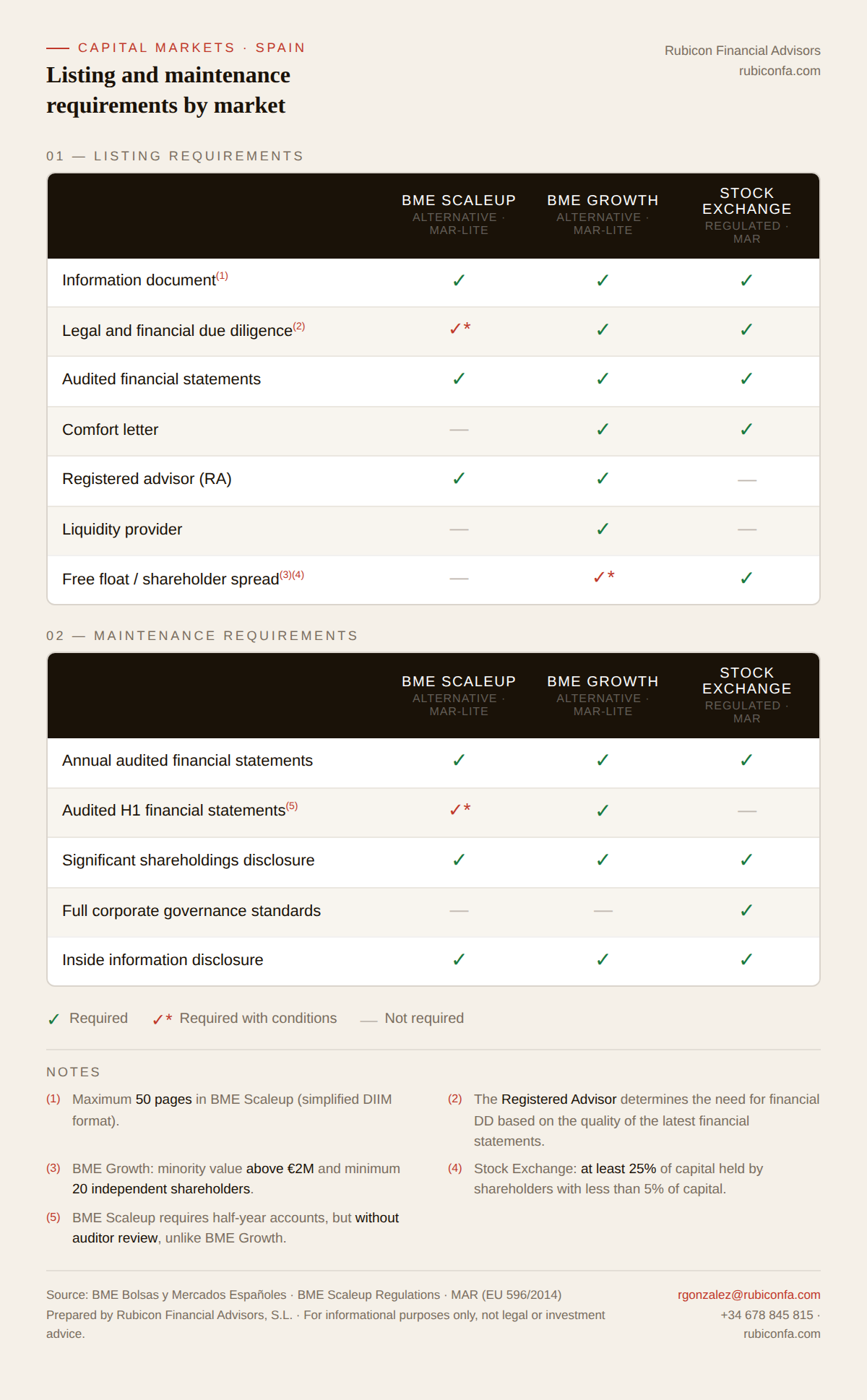
One of the least mentioned structural advantages of BME Scaleup is that it functions as an accelerated gateway to BME Growth. After 18 months of trading on the market and provided that the shareholder spread criteria are met — at least 20 independent shareholders and a retail holding valuation above €2M — the company can make the leap to BME Growth without going through a full admission process.
This makes BME Scaleup more than just a target market: it is the prelude to a broader financial ecosystem, with greater liquidity, greater analyst coverage and access to a more diversified investor universe.
Listing activates an internal improvement cycle that few companies expect: better reporting, greater financial discipline, stronger corporate governance, a clearer narrative for customers, partners and investors. It is not just the capital that comes in on the day of the debut. It is what you build from then on.
BME Scaleup is not for all companies or all moments. The market is suitable for SMEs with a proven business model, sustained growth — ideally above 20% annualised — and a team capable of assuming the obligations of a listed company without distracting the business focus.
Nor is it a process that can be improvised. Proper preparation requires between six and twelve months of internal work before the formal process with the Registered Advisor begins: putting the accounts in order, cleaning up the capital structure, building the business plan, preparing the financial narrative and beginning to cultivate relationships with investors in the ecosystem.
If you are thinking about making the move in the next 12 to 24 months, now is the time to start preparing.
If your company is at that stage — or you simply want to find out whether it is — a 30-minute cal is the best place to start. At Rubicon Financial Advisors we guide companies through the entire process, from the initial assessment to their market debut: pre-listing financial review, deal structuring, investor narrative preparation and access to our network of investors across BME Scaleup, BME Growth and Euronext. No commitment required.
rgonzalez@rubiconfa.com
+34 678 845 815
www.rubiconfa.com